
Quick Answer: Does the US Import Toilet Paper?
Yes. Toilet paper is imported into the United States, although the country also has strong domestic tissue production. Based on USITC DataWeb general import data for HTS 4818.10.0000, US toilet paper imports reached about $575.1 million in 2025, with reported import quantity of about 310,555 metric tons.
For B2B buyers, the important point is not simply whether toilet paper or toilet tissue is imported. The better question is when imports make sense. Imported toilet paper may support cross-border supply, private label programs, specialty materials, backup sourcing, bamboo toilet paper projects or specific price-tier strategies that domestic suppliers may not always cover.
Latest US Toilet Paper Import Data
US toilet paper imports have not followed a straight line over the past few years. Import value fell in 2021 and 2022, then recovered strongly from 2023 onward. By 2025, import value was higher than the 2020 level, while import quantity also moved above 2020.
| Year | Import Value | Import Quantity | Value Change |
|---|---|---|---|
| 2020 | $477.0 million | 290,069 t | — |
| 2021 | $340.0 million | 192,808 t | -28.7% |
| 2022 | $315.4 million | 163,803 t | -7.2% |
| 2023 | $394.6 million | 186,287 t | +25.1% |
| 2024 | $480.6 million | 230,362 t | +21.8% |
| 2025 | $575.1 million | 310,555 t | +19.7% |
Source: USITC DataWeb, General Imports, HTS 4818.10.0000 Toilet paper. The latest complete year in this dataset is 2025. Import value is shown as customs value, and quantity is reported in kilograms and converted here to metric tons.
This trend shows that imports remain part of the US toilet paper supply mix. It does not mean imported toilet paper replaces domestic production. The United States still has a large tissue manufacturing base, but imports can fill specific supply needs, especially when buyers need regional cross-border supply, specialty products, alternative sourcing or private label flexibility.
For importers and distributors, the 2023–2025 recovery is worth watching. A rising import value can reflect higher volume, price changes, product mix changes or a combination of these factors. Buyers should avoid reading the value number alone as proof of higher demand. Import quantity, source country and product positioning need to be reviewed together.
Where Does the US Import Toilet Paper From?
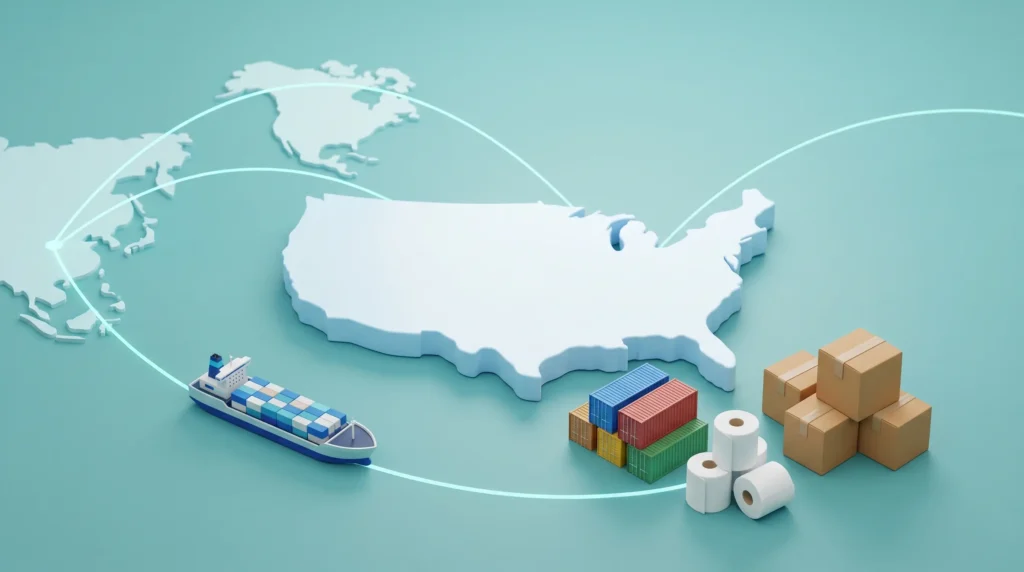
In 2025, Canada was by far the largest source of US toilet paper imports. Mexico, Indonesia and China were also meaningful suppliers, followed by Vietnam, Malaysia and several smaller source countries.
Looking at US toilet paper imports by country helps separate regional cross-border supply from longer-distance overseas sourcing. If buyers ask where toilet paper is shipped from, the answer depends on whether they mean domestic distribution, manufacturing origin or import source country. In US import data, the clearest view is the source country reported in trade records.
| Rank | Country | 2025 Import Value | Share of Value | 2025 Quantity | Share of Quantity |
|---|---|---|---|---|---|
| 1 | Canada | $383.4 million | 66.7% | 166,227 t | 53.5% |
| 2 | Mexico | $63.0 million | 10.9% | 48,698 t | 15.7% |
| 3 | Indonesia | $51.9 million | 9.0% | 39,414 t | 12.7% |
| 4 | China | $35.6 million | 6.2% | 29,801 t | 9.6% |
| 5 | Vietnam | $10.5 million | 1.8% | 9,298 t | 3.0% |
| 6 | Malaysia | $7.4 million | 1.3% | 6,297 t | 2.0% |
| 7 | Trinidad and Tobago | $4.8 million | 0.8% | 2,024 t | 0.7% |
| 8 | Italy | $3.9 million | 0.7% | 1,689 t | 0.5% |
| 9 | Dominican Republic | $2.9 million | 0.5% | 1,082 t | 0.3% |
| 10 | Colombia | $2.3 million | 0.4% | 1,120 t | 0.4% |
This breakdown is useful because US toilet paper imports are not only a China-related topic. Canada alone accounted for about two-thirds of import value in 2025. That points to the importance of North American cross-border supply, not just long-distance overseas sourcing.
Mexico also plays a practical regional role. For buyers, nearby supply can matter when lead time, freight route, replenishment stability or regional distribution is more important than the lowest factory price. Indonesia, China, Vietnam and Malaysia show that Asia-based supply is still relevant, especially when buyers are comparing material options, private label flexibility, packaging capability or alternative sourcing plans.
Why Does the US Import Toilet Paper If It Has Domestic Production?
The United States has an established base of U.S. tissue manufacturers, but domestic production and imports can exist at the same time. Toilet paper is bulky, freight-sensitive and often produced close to the market, yet imports can still make sense when the buyer’s requirement is not fully covered by local supply.
To understand the broader production picture, buyers can also review where toilet paper is manufactured and how regional production differs from import sourcing.
Some imports support regional supply. Canadian and Mexican toilet paper can move into the US market through nearby trade routes, which may help with distribution, replenishment or specific retail and commercial programs. Other imports may support specialty demand, such as bamboo toilet paper, private label wrapping, different roll counts, alternate packaging formats or specific cost and quality targets.
This is why buyers should not treat imported toilet paper as automatically better or worse than domestic toilet paper. A domestic supplier may be stronger for fast replenishment and large standard programs. An import supplier may be more useful for custom packaging, specialty materials, export carton planning, private label development or backup supply outside the buyer’s main source.
The real comparison is not domestic versus imported in a general sense. It is whether the supplier can match the buyer’s target market, roll specification, packaging format, carton size, landed cost and repeat-order requirements.
What US Toilet Paper Imports Mean for B2B Buyers
For B2B buyers, US toilet paper import data is useful because it shows where supply is actually moving, not just where production exists. The numbers show that the US market uses both domestic production and imported supply. That gives buyers more sourcing options, but it also means suppliers should be compared by specification, packaging, lead time and landed cost instead of source country alone.
For toilet paper, toilet tissue and bath tissue buyers, toilet paper roll dimensions affect carton volume and landed cost. Ply, GSM, sheet size, sheet count, roll diameter and core size can all change how many units fit into a carton or container. A low unit price can become less attractive if the roll is bulky, the carton is inefficient or the product does not match the target sales channel.
Custom tissue packaging is another practical issue. Retail multipacks, individual paper wraps, kraft paper packs, hotel and commercial rolls, jumbo rolls and e-commerce cartons all create different cost and handling requirements. Private label tissue projects also need artwork approval, packaging samples, carton marks, compliance documents and repeat production control.
For importers, the safest approach is to compare full landed cost and order reliability, not only factory price. A sourcing plan should include sample approval, packaging confirmation, carton loading, lead time, backup supply and document requirements before a bulk order is confirmed.
Where Bamboo Toilet Paper Fits in US Import Sourcing
Bamboo toilet paper is one reason some buyers look beyond standard domestic supply. Bamboo-based tissue projects often need coordinated sourcing across bamboo pulp, tissue converting, wrapping material, packaging design and export carton planning.
For US buyers, bamboo toilet paper imports may be relevant when the goal is to build an eco-positioned product line, a private label brand, a retail multipack or a specialty e-commerce SKU. The key issue is not only whether the product is imported. Buyers also need to check bamboo pulp material, FSC chain of custody certification where required, bleaching method, ply, GSM, sheet count, roll diameter, paper wrap options and carton packing.
China and other Asia-based supply regions can be relevant for bamboo toilet paper because bamboo pulp sourcing, converting capability and export packaging support often need to be coordinated together. Buyers comparing this sourcing route can also review whether toilet paper is made in China and what that means for origin, manufacturing, and export-oriented supply.
That does not mean every bamboo toilet paper product is the same. Buyers should compare samples, documentation, packaging feasibility and repeat-order consistency before choosing a supplier.
How Newland Bamboo Supports Toilet Paper Import and Private Label Projects
Newland Bamboo supports bamboo toilet paper and related tissue product projects for wholesale, retail, hospitality, e-commerce and private label buyers. For import projects, our role is not only to supply finished rolls. We help buyers review specifications, packaging formats, sample quality and export order details before production.
For bamboo toilet paper projects, buyers can confirm ply, GSM, sheet size, sheet count, roll diameter, core size, embossing, wrapping material, carton packing and certification document needs. For private label projects, artwork requirements, packaging samples, carton marks, MOQ, lead time and repeat-order planning should be reviewed early.
Imported toilet paper works best when the sourcing plan is clear before production. Buyers should prepare the target market, sales channel, preferred pack format, order quantity, price range, certification needs and packaging direction. This helps avoid mismatched samples, unclear quotations and unexpected freight or carton issues.
Buyers comparing US domestic supply with imported bamboo toilet paper can use Newland Bamboo to review product specifications, packaging requirements, sample options and bulk order planning before confirming a sourcing direction.
FAQ About US Toilet Paper Imports
Does the US import toilet paper?
Yes. The United States imports toilet paper. Based on USITC DataWeb general import data for HTS 4818.10.0000, US toilet paper imports reached about $575.1 million in 2025.
Is toilet paper imported?
Yes. Toilet paper can be imported when buyers need cross-border supply, specialty products, private label packaging, bamboo toilet paper, backup sourcing or specific price and quality options.
How much toilet paper does the US import?
In 2025, US general imports under HTS 4818.10.0000 reached about $575.1 million, with reported quantity of about 310,555 metric tons. The data source is USITC DataWeb.
Where does the US import toilet paper from?
In 2025, the leading sources were Canada, Mexico, Indonesia, China, Vietnam and Malaysia. Canada was the largest source by value and quantity.
Does the US import toilet paper from China?
Yes. China supplied about $35.6 million of US toilet paper imports in 2025 under HTS 4818.10.0000, accounting for about 6.2% of import value in this dataset.
Does the US import toilet paper from Canada?
Yes. Canada was the largest source of US toilet paper imports in 2025, accounting for about $383.4 million in import value and about 166,227 metric tons in quantity.
Is toilet paper made in the USA?
Yes. The United States has domestic tissue production, but it also imports toilet paper. Domestic production and imported supply can both exist in the same market because buyers have different product, packaging, cost and sourcing needs.
Why does the US import toilet paper if it has domestic production?
The US imports some toilet paper because imported supply can support cross-border trade, specialty products, private label programs, bamboo toilet paper, backup sourcing and specific price-tier strategies.
Are US toilet paper imports increasing?
US toilet paper import value increased from 2022 to 2025 in the USITC DataWeb dataset used for this guide. Import value rose from about $315.4 million in 2022 to about $575.1 million in 2025.
What should B2B buyers check before importing toilet paper?
B2B buyers should check ply, GSM, sheet size, sheet count, roll diameter, core size, packaging format, certification needs, carton size, loading plan, sample quality, MOQ, lead time and repeat-order consistency.